Lead Scoring Automation: A Complete Guide to Qualifying Leads Faster
Learn how automated lead scoring helps marketing and sales teams prioritize prospects, shorten sales cycles, and boost conversion rates with data-driven strategies.
What Is Automated Lead Scoring?
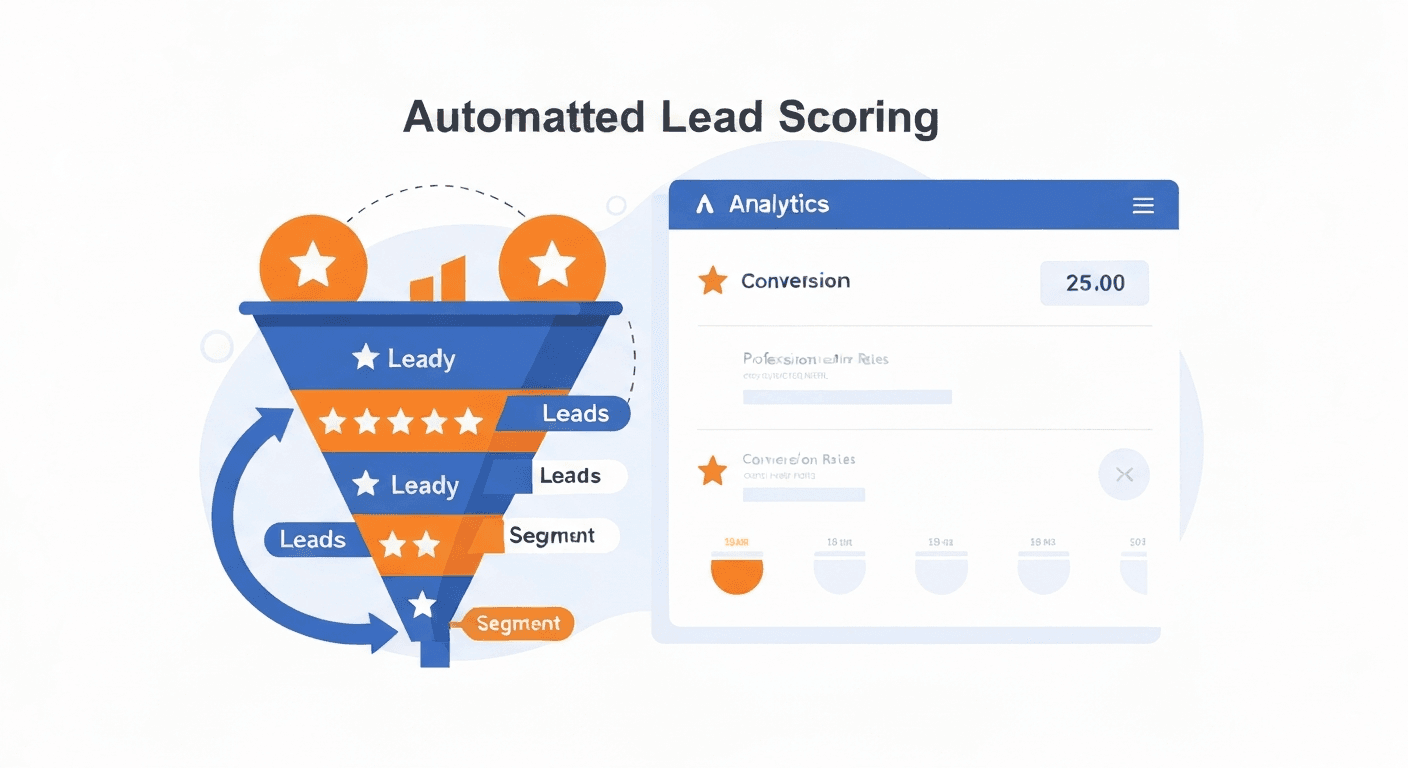
Automated lead scoring is the process of using predefined rules, behavioral data, and sometimes machine learning to assign numerical values to every lead that enters your pipeline. Instead of relying on gut feelings or manual review, an automated system evaluates each prospect based on demographic fit, engagement signals, and buying intent, then ranks them so your sales team knows exactly who to call first.
Traditional lead qualification is slow and subjective. One sales rep might consider a webinar attendee a hot lead, while another dismisses them entirely. Marketing automation removes that inconsistency. Every lead is measured against the same criteria, every time, ensuring that the highest-quality prospects rise to the top of the queue without human bias slowing things down.
The result is a tighter feedback loop between marketing and sales. Marketing delivers better-qualified leads, sales closes more deals, and revenue teams stop arguing about lead quality during Monday morning standups.
Why Does Lead Scoring Matter for Sales Alignment?
The friction between marketing and sales is one of the oldest problems in business. Marketing complains that sales ignores their leads. Sales complains that marketing sends them junk. Lead scoring acts as the common language that bridges this gap.
When both teams agree on what constitutes a qualified lead, and that definition is enforced automatically, several things happen:
- Sales reps spend time on the right prospects. Instead of dialing through a list alphabetically, they start with leads that have the highest probability of converting.
- Marketing gets measurable feedback. If scored leads consistently convert, the scoring model is working. If they do not, the model needs tuning.
- Pipeline velocity increases. Leads move from first touch to closed deal faster because nobody wastes time on prospects who are not ready to buy.
- Customer acquisition cost drops. Fewer wasted calls and emails mean lower cost per conversion.
Research from multiple industry sources consistently shows that organizations with mature lead scoring processes see significantly higher close rates compared to those without any scoring system in place. That improvement comes directly from focusing effort where it matters most.
How Do You Build a Lead Scoring Model?
Building an effective lead scoring model requires input from both marketing and sales. Here is a step-by-step approach that works for most B2B organizations.
Step 1: Define Your Ideal Customer Profile
Start by examining your best existing customers. Look for patterns in:
- Company size (revenue, employee count)
- Industry vertical
- Job title or seniority of the decision-maker
- Technology stack they already use
- Geographic location
These demographic and firmographic attributes form the foundation of your scoring model. A VP of Marketing at a mid-market SaaS company might score higher than an intern at a Fortune 500 firm, depending on your product.
Step 2: Identify High-Intent Behavioral Signals
Demographics tell you who the lead is. Behavior tells you how interested they are. Track and score actions such as:
- Website visits: Visiting the pricing page is a stronger signal than reading a blog post.
- Email engagement: Opening an email is one thing. Clicking through to a product demo page is another.
- Content downloads: A prospect who downloads a case study is further along than one who downloads a general industry report.
- Webinar attendance: Live attendance signals higher intent than registering but not showing up.
- Free trial or demo requests: These are the strongest buying signals and should carry the highest point values.
- Social media interactions: Engaging with your brand on LinkedIn or other platforms can indicate awareness-stage interest.
Step 3: Assign Point Values
Create a point scale, commonly 0 to 100, and assign values to each attribute and behavior. Here is a simplified example:
- Matches ideal industry: +15 points
- Decision-maker title: +20 points
- Visited pricing page: +20 points
- Downloaded case study: +10 points
- Requested demo: +25 points
- Opened email but no click: +3 points
- Unsubscribed from emails: -15 points
Notice that negative scoring is just as important as positive scoring. A lead who unsubscribes, bounces from your site in under five seconds, or works in an industry you do not serve should have their score reduced automatically.
Step 4: Set Thresholds
Define clear score ranges that trigger specific actions:
- 0-30 points: Nurture with educational content. Not ready for sales.
- 31-60 points: Marketing Qualified Lead (MQL). Increase engagement frequency.
- 61-80 points: Sales Qualified Lead (SQL). Route to sales for outreach.
- 81-100 points: Hot lead. Immediate sales follow-up required.
These thresholds should be agreed upon by both marketing and sales leadership before the system goes live.
What Tools Can You Use for Lead Scoring Automation?
Most modern marketing automation platforms include built-in lead scoring capabilities. Here are the most common options:
- HubSpot: Offers both manual and predictive lead scoring. The predictive model uses machine learning to analyze thousands of data points and surface the leads most likely to close.
- Marketo (Adobe): Provides highly customizable scoring models with behavioral and demographic dimensions. Well-suited for enterprise organizations with complex sales cycles.
- Salesforce Pardot: Tight integration with Salesforce CRM makes it easy to pass scored leads directly to sales reps within their existing workflow.
- ActiveCampaign: A strong mid-market option that combines email automation, CRM, and lead scoring in a single platform.
- Zoho CRM: Offers scoring rules alongside its broader CRM and marketing suite, making it a budget-friendly choice for small businesses.
The right tool depends on your existing tech stack, budget, and the complexity of your sales process. The most important factor is that whatever platform you choose integrates cleanly with your CRM so scored leads flow directly to the right sales rep without manual handoffs — see our CRM and marketing automation integration guide for how to set that up cleanly.
How Do You Integrate Lead Scoring With Your CRM?
The scoring model is only useful if it connects to your sales workflow. Here is how to ensure seamless integration:
- Map score fields to your CRM. Create a custom field in your CRM that receives the lead score from your marketing automation platform. This field should update in real time as lead behavior changes.
- Set up automated routing. When a lead crosses the SQL threshold, trigger an automated assignment to the appropriate sales rep based on territory, industry, or round-robin rules.
- Create sales alerts. Configure instant notifications, whether via email, Slack, or in-app alerts, so reps know the moment a high-scoring lead needs attention.
- Build reporting dashboards. Track metrics like MQL-to-SQL conversion rate, average time from MQL to closed deal, and score accuracy over time.
- Establish a feedback loop. Sales reps should be able to flag leads as "good fit" or "bad fit" after conversations, feeding data back into the scoring model for continuous improvement.
What Are Common Lead Scoring Mistakes to Avoid?
Even well-intentioned scoring models can fail. Watch out for these pitfalls:
- Overcomplicating the model. Start with 8-12 scoring criteria, not 50. You can always add complexity later.
- Ignoring negative signals. Leads that go cold, unsubscribe, or visit your careers page instead of your product page should lose points.
- Never recalibrating. A scoring model built in Q1 may not reflect market changes by Q4. Review and adjust your model quarterly.
- Scoring without sales buy-in. If sales does not trust the scores, they will ignore them. Involve sales leadership from day one.
- Treating all behaviors equally. A pricing page visit is not the same as a blog page view. Weight actions according to their correlation with actual closed deals.
How Do You Measure Lead Scoring Effectiveness?
You need clear metrics to know whether your scoring model is actually working. Track these KPIs:
- MQL-to-SQL conversion rate: Are marketing qualified leads actually converting to sales qualified leads? If not, your MQL threshold may be too low.
- SQL-to-opportunity rate: Are sales-accepted leads turning into real pipeline? This measures score accuracy.
- Average deal cycle length: Effective scoring should shorten the time from first touch to closed deal.
- Lead-to-customer conversion rate by score range: Leads with higher scores should convert at meaningfully higher rates. If they do not, the model needs work.
- Sales acceptance rate: What percentage of leads passed to sales are actually accepted and worked? Low acceptance suggests misalignment.
Review these metrics monthly and hold joint marketing-sales meetings to discuss findings. The scoring model should be treated as a living system, not a set-it-and-forget-it configuration.
What Does the Future of Lead Scoring Look Like?
Predictive lead scoring powered by artificial intelligence is rapidly becoming the standard. Instead of manually assigning point values, machine learning models analyze historical conversion data to identify the attributes and behaviors that actually predict closed deals.
These AI-driven models can surface patterns that humans miss, like the fact that leads who visit three specific pages in a single session are four times more likely to buy, or that companies in a particular revenue range close faster than others.
As these tools mature, expect lead scoring to become less about rigid rules and more about dynamic, self-optimizing models that improve with every deal your team closes or loses.
The companies that invest in automated lead scoring now will build a compounding advantage over competitors still sorting through spreadsheets. Start simple, measure relentlessly, and refine your model over time. Your sales team, and your revenue targets, will thank you.
Harry Harrison
Founder & Editor, Easy Automation
Tech-forward B2B writer and content strategist focused on marketing and finance automation.